2009-08-30
More on show: projector problem
Data projectors ('beamers' in our corner of the Continent) are tricky enough even when not miniaturised into photo cameras (see previous post): during our Club evening, yesterday, I counted on using the room's built-in projector with the special settings we had laboriously made for it. In fact, Louis and me had spent the best part of two hours fiddling with all settings and had stored our best (i.e. reasonable, not perfect!) settings. Friday night I loaded "our" settings, but when we watched and discussed forty or so photos over the evening, the bad rendering of colour and contrast on the screen made serious photographic discussions quite difficult. And then to think that this ASK Proxima was judged to be one of the best of the € 1,000 projectors, a year ago by Focus. What is the solution? Should our camera club buy its own projector, of € 3,000? Unlikely--but if not, what then to do?


2009-08-23
Compact to show
I'm a bit behind on the camera release front, and no wonder (I soothe myself), because new cameras are announced almost daily. But this one is worth noticing: early August, Nikon announced a compact camera with built-in projector. It should give you a view of up to 40", instead of the 2 to 3" screens at the back of compact cameras before which we now have to rub our heads with other onlookers to get a faint idea of the new baby, or whatever people take pictures of. I like the idea of being more aware of the fact that photos are there not just to be taken, but to be viewed. Viewing should be made as simple as possible--quite in agreement with Nikon, and also with other camera makers who let you upload seamlessly to web galleries and social network sites. But will this built-in projector work?
There are some drawbacks. Not the 40" maximum size; that's more than most home tv screens. But that is the maximum, probably only reached under ideal circumstances (no disturbing environmental light, a good flat and white background, I guess). Besides, your tv nowadays has up to HD resolution (1920x1080 pixels, about 2 megapixel--still less than modern phone cameras, let alone good compacts or DSLRs), while this camera-projector is said to have VGA resolution; that means 640x480 or 0.3 megapixel. That won't look good at 40" size, not even if you take the larger viewing distance into account. (The relevance of viewing distance: People look at a small-size picture from a small viewing distance, so it needs a higher resolution to seem sharp than a large-size picture, which they need to step back from to take it all in at a single viewing.)
Besides, I wonder about the colour rendering of the small built-in projector. In our camera club, we worked for close to two hours with a normal-size projector to get its colours more or less right by tweaking all kinds of menu settings against a number of test pictures, from colour cards to 'real life' photos including landscapes, portraits, etc. (No, we don't have a calibration apparatus for LCD projectors--but that's another sad story.) And that was with a fairly new projector already in use, which had been installed by a professional seller and which the non-camera club users found quite alright and convincing as for its colour rendering.
I don't want to forget to mention that the battery time for projecting would be no more than one hour. Probably that's even quite a feat, technically--and more than enough for the slide shows you want to submit your family and friends to. Maybe they should have limited slide show duration to twenty minutes, for the sake of the family and friends ;-)
All in all, Nikon had a good idea, but I'm sceptical as to its practical use. I'll wait for the third generation of such cameras-cum-projector. At least the third generation.
There are some drawbacks. Not the 40" maximum size; that's more than most home tv screens. But that is the maximum, probably only reached under ideal circumstances (no disturbing environmental light, a good flat and white background, I guess). Besides, your tv nowadays has up to HD resolution (1920x1080 pixels, about 2 megapixel--still less than modern phone cameras, let alone good compacts or DSLRs), while this camera-projector is said to have VGA resolution; that means 640x480 or 0.3 megapixel. That won't look good at 40" size, not even if you take the larger viewing distance into account. (The relevance of viewing distance: People look at a small-size picture from a small viewing distance, so it needs a higher resolution to seem sharp than a large-size picture, which they need to step back from to take it all in at a single viewing.)
Besides, I wonder about the colour rendering of the small built-in projector. In our camera club, we worked for close to two hours with a normal-size projector to get its colours more or less right by tweaking all kinds of menu settings against a number of test pictures, from colour cards to 'real life' photos including landscapes, portraits, etc. (No, we don't have a calibration apparatus for LCD projectors--but that's another sad story.) And that was with a fairly new projector already in use, which had been installed by a professional seller and which the non-camera club users found quite alright and convincing as for its colour rendering.
I don't want to forget to mention that the battery time for projecting would be no more than one hour. Probably that's even quite a feat, technically--and more than enough for the slide shows you want to submit your family and friends to. Maybe they should have limited slide show duration to twenty minutes, for the sake of the family and friends ;-)
All in all, Nikon had a good idea, but I'm sceptical as to its practical use. I'll wait for the third generation of such cameras-cum-projector. At least the third generation.
2009-08-22
Every so often... you just have to take that picture

"Every so often, you turn a corner and there it is--a great photograph." That is how Guardian photographer Eamonn McCabe summarised his fascination with (black & white) photography. He felt inspired by a book of the same title, Every so often, by another photographer, Raymond Moore. It's a matter of (quoting McCabe's column in August's Black+White Photography again): "just enjoying the process of looking". I agree, and whished I had a camera built into my eyes: you just click your fingers (that is an allusion to a recent song by Daniel Lohues, of course) and then it's stored in your memory. So even when I don't have a good camera with me, sometimes I just have to take that photograph--as this one, in the streets of Athens, in 2007. What did that junk do in the street? Why is the passer-by looking at it, or beyond it through the window? Never mind the technically bad quality of the photo, use that little old compact (as in this case) or even your phone's camera. Point and shoot--to keep wondering whenever you see the picture again about a moment you otherwise would have forgotten.
2009-08-16
Landscape book -- little gem with flaws
A book on landscape photography is what I picked up in a 'modern antiques' bookstore ('ramsj', in Yiddish-Dutch), when my daughter drgged me into it. (A matter of self-protection, as I would be certain to come out with too many books if I let meyself loose in such a store...). It was the Dutch version of 'The World's Top Photographers - Landscapes' edited by Terry Hope. You may find little gems among the rubbish of those cheap bookstores, so do go and have a look--if you can control yourself ;-)
The book itself is still on sale in the main online bookstores (no advertisements by me; you can find your own).
It contains two spreads with a little bit of text and one to circa four photos from 38 photographers, ordered alphabetically. The photos are quite nice--'inspiring' in the not too far from true enthusiastic parlance of the Introduction--and the texts give a good impression of what it takes to be a good landscape photographer. Knowing your special corner of the world and a lot of persistence are among the key ingredients, so much is clear to me already after leafing through just a few of the photographers' little chapters.
It is only too noticeable that the book originally was published in 2003, before the digital revolution in photography. All photos are made on film (almost invariably Fuji, just a few on Kodak--I used to prefer the fuller Fuji colours, too). Of course, there still are many landscpae photographers who work on film, especially in the large cameras (4x5 inch, etc.). But many now also work digitally, and that is not found in this book. Besides, I would have liked more detailed technical information with the photos: what is the use of knowing the brand of camera or film, but not the aperture and shutter speed (plus ISO setting)? For instance, the trick of getting the 'glazed' smoothness of the sea in some photos depends on the shutter speed and then I'd like to learn if it takes 2, 20 or 200 seconds for getting that effect.
 Annoying about the Dutch translation is that it was not done by a photographer, otherwise the translation of 'tripod' would not have been the literal 'driepoot' but the correct 'statief', for instance. So I found the book a gem with little flaws, but it will be useful on many rainy days for getting more inspiration!
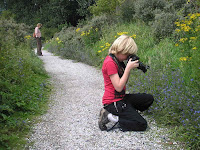
The photo here is just a little illustration of landscape and nature photography 'learned young'. As my daughter had my DSLR, I took her picture with the small compact camera--good enough for the purpose. I tried to take care of some composition rules (object at 1/3), and felt aided by the S-curve in the park's path to suggest depth. What's the flaw in this little gem?
The book itself is still on sale in the main online bookstores (no advertisements by me; you can find your own).
It contains two spreads with a little bit of text and one to circa four photos from 38 photographers, ordered alphabetically. The photos are quite nice--'inspiring' in the not too far from true enthusiastic parlance of the Introduction--and the texts give a good impression of what it takes to be a good landscape photographer. Knowing your special corner of the world and a lot of persistence are among the key ingredients, so much is clear to me already after leafing through just a few of the photographers' little chapters.
It is only too noticeable that the book originally was published in 2003, before the digital revolution in photography. All photos are made on film (almost invariably Fuji, just a few on Kodak--I used to prefer the fuller Fuji colours, too). Of course, there still are many landscpae photographers who work on film, especially in the large cameras (4x5 inch, etc.). But many now also work digitally, and that is not found in this book. Besides, I would have liked more detailed technical information with the photos: what is the use of knowing the brand of camera or film, but not the aperture and shutter speed (plus ISO setting)? For instance, the trick of getting the 'glazed' smoothness of the sea in some photos depends on the shutter speed and then I'd like to learn if it takes 2, 20 or 200 seconds for getting that effect.
 Annoying about the Dutch translation is that it was not done by a photographer, otherwise the translation of 'tripod' would not have been the literal 'driepoot' but the correct 'statief', for instance. So I found the book a gem with little flaws, but it will be useful on many rainy days for getting more inspiration!
The photo here is just a little illustration of landscape and nature photography 'learned young'. As my daughter had my DSLR, I took her picture with the small compact camera--good enough for the purpose. I tried to take care of some composition rules (object at 1/3), and felt aided by the S-curve in the park's path to suggest depth. What's the flaw in this little gem?
2009-08-09
Pokeweed revisited with bonus
Looking at the same spike of the Pokeweed that I showed here a week ago, it looks quite different now (overview of the plant below), with all berries that were ripening last week already disappeared (eaten by birds?) and the last few, at the top of the spike, blackening now. But the bonus this time was the orange ladybird (there must be umpteen kinds of ladybirds!) scourgng the little berries for aphids and the like. Problem for the photographer: such a little insect is faster than you think, and it always seems to sit at the wrong side of the spike.
Info for other photographers: although this photo was made in subdued daylight (it was a cloudy day), I used a (normal set-up) flash to get the highlights. More importantly: the flash enabled using a short enough shutter speed to avoid blur due to the wind.


Info for other photographers: although this photo was made in subdued daylight (it was a cloudy day), I used a (normal set-up) flash to get the highlights. More importantly: the flash enabled using a short enough shutter speed to avoid blur due to the wind.

Subscribe to:
Posts (Atom)